Home > Insights > JoeySat: Successful Mission Showcases the Evolution of Recon
By MDA Space - June 9, 2026
JoeySat: Successful Mission Showcases the Evolution of Reconfigurable Satellite Networks
The Shift Toward More Flexible Satellite Architectures
Satellite communications networks are entering a period of architectural transition. As demand grows for constant connectivity, higher throughput and more responsive coverage, operators and other stakeholders are increasingly evaluating how satellite infrastructure can become more adaptive, scalable and operationally flexible.
Traditional payload architectures, while highly capable, were largely designed around fixed coverage plans and predetermined capacity allocation. That model is becoming more difficult to sustain in an environment where user demand, operational priorities and spectrum use can shift rapidly across regions and mission types.
As next-generation Low Earth Orbit (LEO) constellations continue to expand, software-defined payloads, digital beamforming and dynamic resource management are becoming increasingly important components of resilient space infrastructure.
Demonstrating Dynamic Beamforming and Onboard Processing in Orbit
That transition was a central focus of the European Space Agency’s (ESA) JoeySat technology demonstrator – part of the Sunrise Partnership Project between ESA and satellite operator Eutelsat, supported by the UK Space Agency.
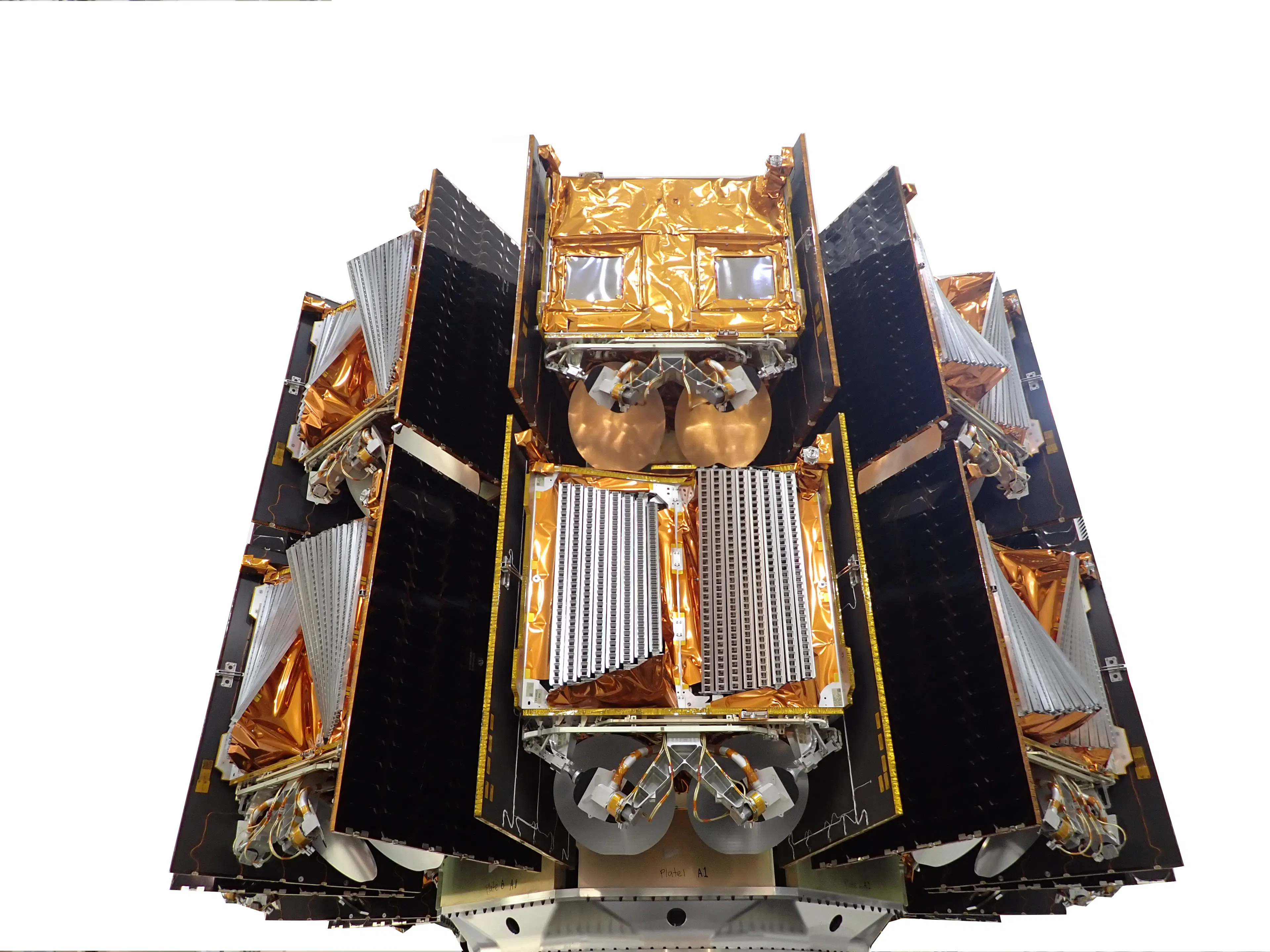
Hosted aboard a commercial OneWeb satellite launched on a Falcon 9 rideshare mission in May 2023, JoeySat was designed to validate key technologies required for future reconfigurable satellite networks, including digital beamforming, beam hopping, regenerative onboard processing and dynamic resource allocation. The fully digital payload was designed and built in less than 18 months by a compact engineering team of fewer than 20 engineers from MDA Space in the UK.
Operating in a 600 km polar orbit with near-global coverage, JoeySat showed how advanced communications payload capabilities can be integrated into a live commercial LEO broadband satellite while maintaining a low-cost and rapidly deployable development model.
At the core of the payload is a pair of sophisticated MDA Space Application-Specific Integrated Circuits (ASICs), which successfully supported continuous Ku-band beam steering, beam hopping across four ground cells and simultaneous operation of two Ku-band beams, for next-generation LEO services. Those ASICs are precursors to the SX4000 and the Prime2.0 ASICs.
JoeySat also validated dynamic resource allocation capabilities, enabling real-time reallocation of bandwidth and power between coverage cells based on operational demand, and a broader suite of operational capabilities including feeder link operations, in-band telemetry and control, payload health management, user link routing and remote software updates.
One of the mission’s notable operational achievements was the successful application of remote software and firmware updates within a single orbital window without interrupting communications services. There were meaningful efficiency gains through regenerative processing, achieving approximately 3.2 bits/s/Hz spectral efficiency on the gateway downlink compared with 1.9 bits/s/Hz on the user uplink configuration — an improvement of roughly 70%.
Originally designed for a six-month mission with a one-year stretch objective, JoeySat continues to operate more than three years after launch.
Why JoeySat Matters for Future LEO Networks
The operational model behind the mission was just as important as the design. Rather than being deployed as a standalone spacecraft, JoeySat operated as a hosted payload within an existing commercial LEO network, which goes to show that missions and technology demonstrations can be integrated into commercial infrastructure to reduce cost, accelerate deployment timelines and increase in-orbit testing opportunities.
The programme also highlighted the growing viability of lower-cost, high-performance payload development using commercially oriented design approaches and COTS-based subsystems across both the payload and ground segment.
The implications extend beyond a single demonstration mission. Future communications architectures — both commercial and sovereign — are expected to rely increasingly on reconfigurable payloads capable of adapting coverage, throughput and mission priorities dynamically over time. Beam hopping, digital processing and software-defined resource allocation are becoming foundational capabilities for next-generation multi-orbit networks.
JoeySat demonstrated that many of these capabilities can now be deployed, updated and operated successfully within live commercial LEO satellites.
For MDA Space, the mission reflects a broader focus on scalable digital payload architectures and operationally flexible communications systems designed to support the evolving requirements of future satellite networks.