
MDA Space Demos Autonomous Lunar Logistics Capability for the Canadian Space Agency
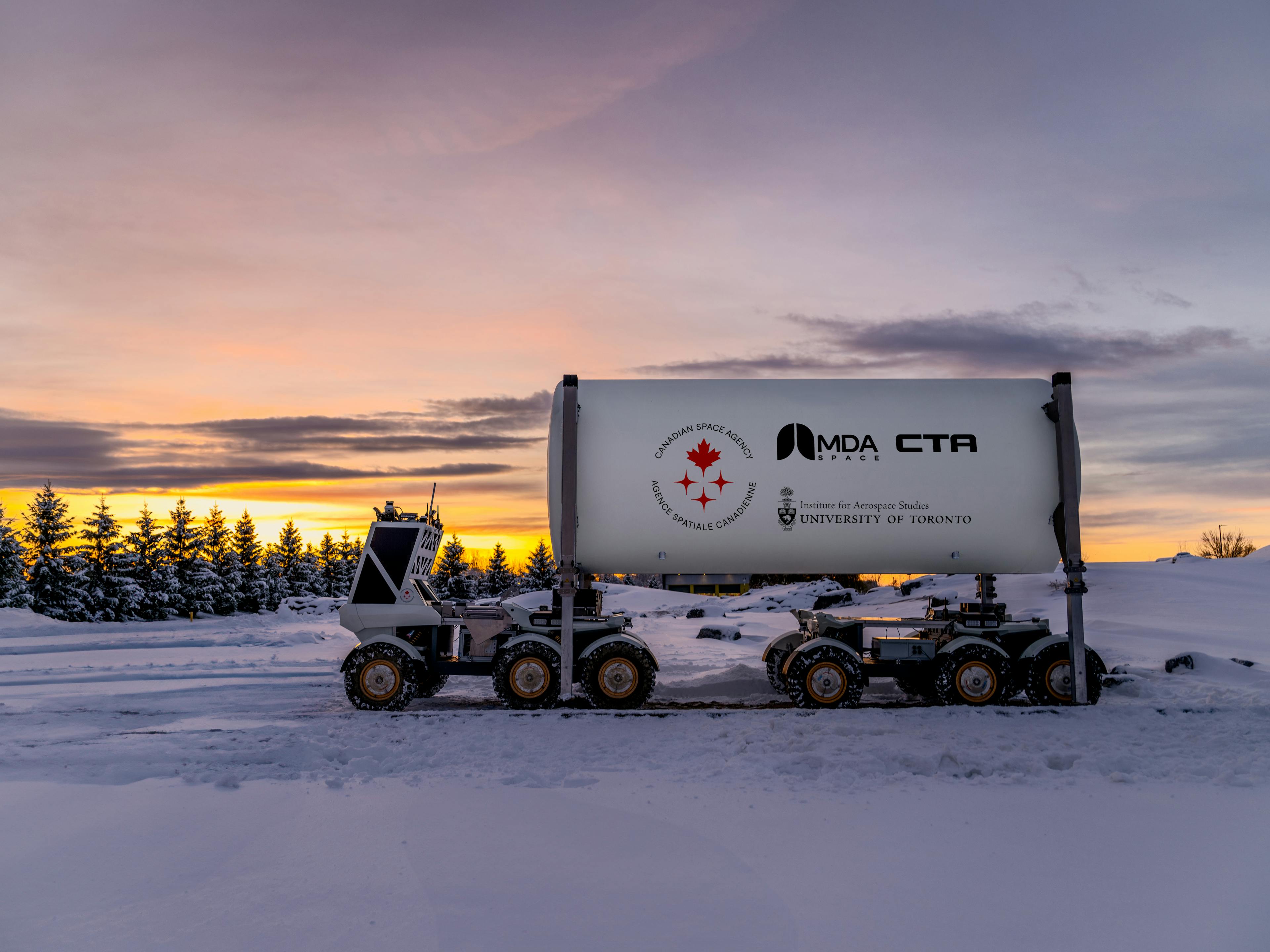
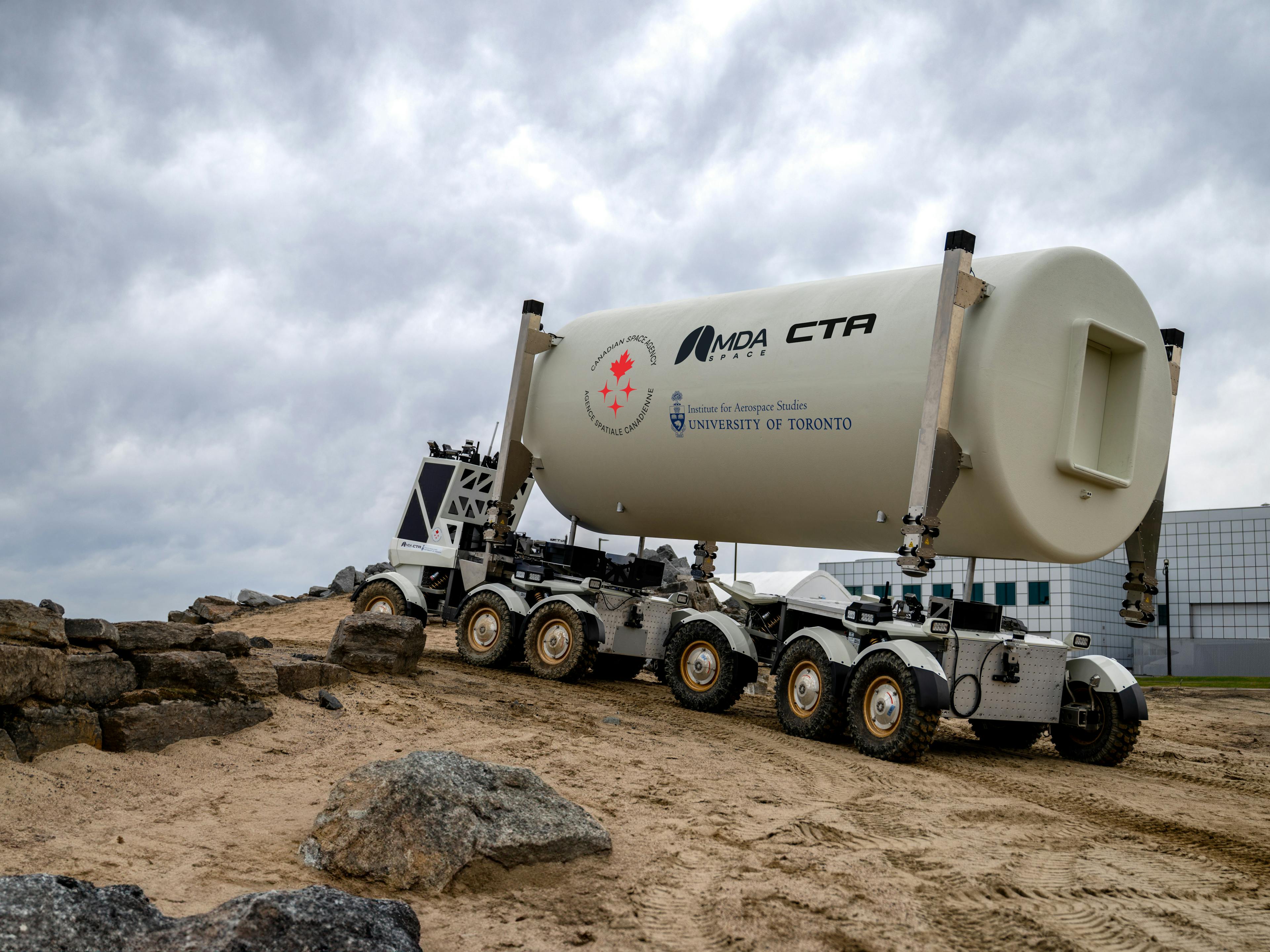
MDA Space just returned from Montréal, Quebec, where we successfully showcased our autonomous lunar logistics capabilities for the Canadian Space Agency’s (CSA) lunar utility rover.
The prototype logistics vehicle is part of an early-phase study for the CSA. The goal is to develop a lunar rover to support crewed and uncrewed missions with a range of tasks—from transportation and construction to scientific investigations—pivotal to humanity’s return to the Moon.
Bringing together the brightest minds in Canada
Our prototype was built in a collaborative effort between three iconic Canadian institutions: the Centre de Technologies Avancées – BRP – UdeS (CTA), the University of Toronto Institute for Aerospace Studies (UTIAS), and MDA Space.
Combining CTA’s expertise in vehicle engineering, UTIAS’s advanced autonomy algorithms and MDA SKYMAKER™, the robotics solution derived from legendary Canadarm technology, the prototype was made to maneuver on the Moon. It can transport cargo across challenging terrain, handle multi-tonne payloads, and operate autonomously, semi-autonomously, or manually from a command centre as far away as Earth.
Autonomy, collaboration on full display
Held on the CSA’s analogue terrain in Saint-Hubert, Quebec, a rocky and unpredictable surface meant to mirror the Moon’s, the demonstration tested the rover’s ability to transport large cargo from a landing site to a habitat.
With its multi-tonne payload spanning two vehicles, our prototype lifted the cargo off the ground and marched on, a hallmark of the rover’s design known as continuous autonomous driving. The two vehicles then travelled in tandem without intervention on their charted path, enabled by UTIAS’s teach and repeat autonomy algorithms. When the rover reached its destination, the cargo was offloaded inches from the mock habitat.
MDA SKYMAKER™, meanwhile, showed the same dexterity that made its predecessor an industry and international legend, transporting much smaller payloads and manipulating external umbilicals on the cargo and habitat.
All told, the demonstration successfully validated the prototype’s capabilities in operating autonomously and transporting cargo across challenging terrain, while producing a surplus of information to analyze and implement for the future.
But more than a technical display, this was also a demonstration of Canadian ingenuity, with three trusted mission partners working together—here on the ground—to solve problems as big as the Moon.
Building mobility in space from the ground up
The lunar utility rover builds on our experience developing the navigation cameras, wheels, locomotion chassis and electronics for the Rosalind Franklin rover for the European Space Agency’s (ESA) ExoMars mission. Expected to launch in 2028, the Rosalind Franklin rover will collect samples on Mars to investigate whether life ever existed on the planet.
From Mars to the Moon, MDA Space is committed to building mission critical solutions for partners around the world, continuing Canada’s legacy as a leader in space exploration.